Traces, people and places

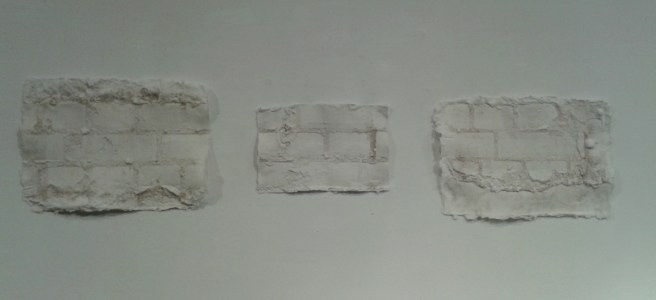
IMG_0436

This is a rubbing of the exterior wall of the building pictured below in the old mining village of Nenthead.  It was built as a smelting house when the mines were still working (now being used as a coach shed) and was architecturally innovative in its time, with an external steel frame (the diagonal in the rubbing).  It is unsafe and soon to be demolished so I was keen to catch a trace of it.

Image result for nenthead smelting house

I was on holiday walking around moors and valleys on the borders of Durham, Northumberland and Cumbria (those four words are a like a little found poem- these places are dear to me).  The landscape is marked by the remains of hundreds of years of mining and related industries.  The pit-heads, slag-heaps, shafts, chimneys and access tunnels, and the huge cavities scoured out of the land, have a brutalist aspect, in terms of the damage done.  But they also resonate with the scale and bleakness of the moorland and the naturally occurring, bony, exposed rocks- made of the same stuff as the old buildings now crumbling back into the ground.

So rich pickings for me in terms of people, place, history and Doreen Massey- style reflections on space and politics.  I have taken digital and film photographs, brought home stones and pressed flowers (Comfrey and Sweet Cicely, another found poem).  I’ve got a painful hip at the moment so, less time spent walking but more time talking to people and gathering their stories.  I like doing this very much and am quite bold in engaging with people- though this is much easier when the locals are as friendly as they are up there.

Also found this fascinating bit of local history at https://northernvicar.wordpress.com/2012/07/12/nenthead-st-john/

(Nenthead) is England’s highest village at 1,500 feet, and has been a major centre for lead and silver mining. The London Lead Company was formed by Quakers in 1704, and they recognised the moral responsibility they had to their workers. It is probably the first purpose-built industrial village in England and laid the foundations for today’s social welfare system. The Quakers built decent housing, a school (compulsory schooling for all children), a reading room (free lending library), public baths and a wash-house for the miners and their families. Apparently it was the first village in the UK to have electric street lighting from excess power generated by the mines.

The picture below is of a back garden in Nenthead, a lovely example of ‘outsider art’.  Buildings from the village and further afield have been recreated in miniature using appropriate stone and building materials and methods.  Lowson Robinson, now retired from working in the mining industry, has created a model of the Quakers’ original model village, as well as Big Ben (because he doesn’t like wearing a watch) and other buildings which take his fancy.  Whilst the real buildings and industries are declining, falling into disrepair or being demolished, Lowson is re-making the space, with authenticity and care, and keeping the stories alive.

Creator: Retired builder Lowson Robinson has downsized and has focused his attention on miniature buildings in his own garden

Some new places

Words make worlds
20150521_173740

This is a cyanotype of Gledhow Valley Wood- digital pic on camera on phone transferred to an A4 acetate after a bit of Photoshopping (grayscale, upping the contrast using levels, and turning into a negative).  This was then placed on Fabriano paper freshly painted (and dried) with 2 coats of cyanotype fluid and developed in the May sunshine at college. I did a series of these to submit to the Chapel Allerton Arts Festival, and for showing in one of the cafe/bars in the ‘village’, perhaps framing and/or printing onto little cards for sale.

I’m also looking at doing contact and lumen prints with the cyanotype medium and with out of date colour photographic paper and liquid light.  I want to gather stuff from different places to use (organic, inorganic, found bits and pieces) for the site-specific work I am doing at St John’s Church and Chapel Allerton.  I want to explore the potential and develop the techniques as part of my toolkit for expressing the themes which are forming as the ‘point’ of my practice.  I am still reaching for this and content to stay with, and trust the process. It feels like groping about among the ideas, unsure but really interested (in too many things?), always a bit too ‘broad brush’ and ill-defined but trying to think deeply and with sincerity about what I care about.  This definitely includes the matter of people and our connection to place, the traces and stories we leave behind.  Also, what that connection means, what it looks like, what makes it like this, in these times when the place we live is being damaged by us so catastrophically.

20150516_144208

Another aspect is people and conversation/activism.  The image above is from a conversation event for women which I organised (as part of a 5-strong hosting team) sparked by a pamphlet by Bea Campbell, End of Equality.

We were planning this for several months, building trust within the hosting team, making connections around the city, and refining our plans and expectations. On reflecting together, we agreed that we had achieved our aims:

  • To respond to Bea’s book and to find out what we all think is going on in these times
  • To chuck a pebble in the pond- get women together to talk and see what happens next- hoping that more things will happen and wanting to stay involved
  • To recognise and support the new wave of women’s activism

I am currently gathering images, text and film material to ‘harvest’ the event, aiming to put some of it in the MA room for the End of Year Shows at College.  I am working with a film-maker, photographer and poet, who helped on the day (partly ‘paid for’ with my hours on Leeds Creative Timebank) to produce short films and a photo-poem book, as well as a narrative report including all the ripples from our ‘pebble in the pond’.  These will also be published on social media, links to be included in a future blog entry.

Where the art is

20150514_143607120150514_1435441

Here are some liquid light images that I did yesterday in the darkroom.  They are 35mm film photographs developed and printed onto Fabriano paper.  I took the pics on our college trip to Warsaw in February.  These show the Soviet-built People’s Palace of Science and Culture.  I am happy with the images- the grey magnificence/vainglory of the building, foregrounded by the effortless grace of trees tracing intricate, delicate patterns in the air. I might put them in frames (I did a lot- some stones and a dozen or so prints onto paper) for our scratch show, as part of the end of year extravaganza at College in June.

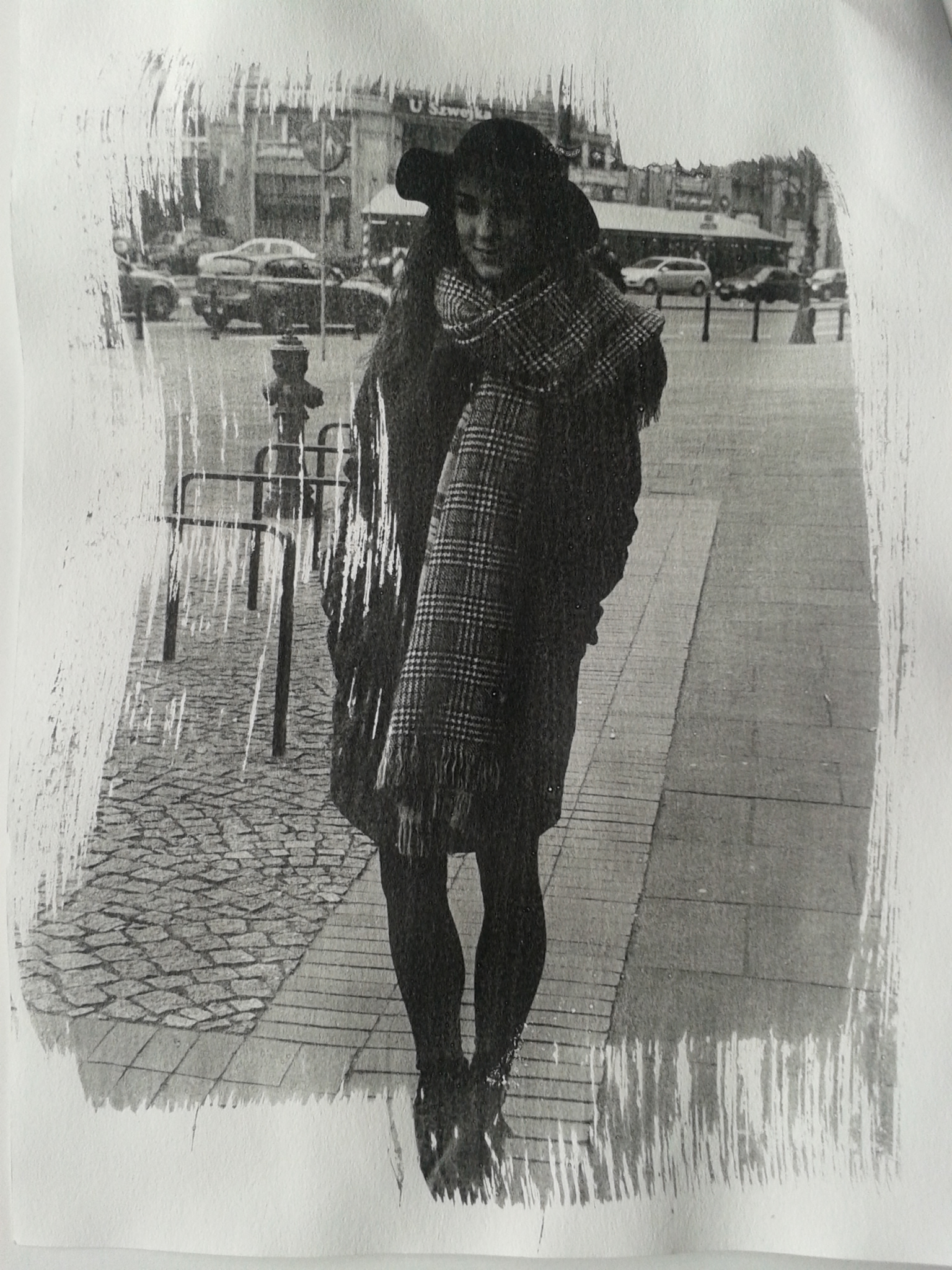
I made an effort to frame the prints well, trying to ensure that the picture appeared within the area covered with the liquid light (not easy because you can’t see where it sits on the paper).  I tried to do just a couple of simple broad brush-strokes in the middle of the paper and it mostly has worked.  I don’t like to see the edge of the negative, rather I aim for it to look as if the image itself has been brushed on, as below.  This is a young woman who was handing out leaflets on Sunday morning, looking elegant and charming.  I asked her permission to take this pic and she posed beautifully.  This is a bit of a departure for me.  I don’t like the idea of street photography, without permission- too much like soul-stealing- but this seemed fine.  I took a few others of women and a little girl which I might print later.  So I was pleased with how this looks on the page- I missed her feet but got her head, probably more important.

20150514_150128

There is a lot to blog about at the moment, and I now have only 30 minutes or so, so will need to come back to catch all the things that are going on.

Two main projects to write about:

1.  End of Equality

Bea Campbell is the main draw for this conversation event for women in Leeds on May 16th.  We have over 70 women registered, and lots more who are coming but haven’t let us know except by work of mouth, so we’re expecting 70-80. My main interest is in the ‘harvesting’- so we’re filming, taking still photographs, recording with words and pictures and doing some poetic word-gathering.  This will get published on our Facebook page, on YouTube, and in a book I aim to make of photo-poems.  I’ve asked everyone in the planning group what they want from the harvest and we’re discussing it at our meeting tomorrow. I’m expecting the unexpected, as well as great things.

2.  Love Arts/Light Night collaborative project

Siobhan Maguire-Broad invited Carol Sorhaindo and me to work together on a submission to the Love Arts festival this October.  We are all MA students, with an interest in site-specific, image-based responses to particular environments- finding and recording the stories of evocative places.

We are working on a collaborative, creative response to St John’s Church in town (and the surrounding green space) for a show inside the church as part of the Festival, which also might be included in the Light Night shenanigans (we hope so).  Themes are Death and Light, so we are thinking about shadows, seeking stories and meaning in and around the church, including underneath the surfaces.  I’ve got a massive roll of out-of-date colour photographic paper which we might use to create lumen prints from the ‘stuff’ of the place, debris, unacknowledged beauty, ‘rubbish’…  I’d like to do rubbings and overlay them with other images, prints etc… Might do some B&W pics onto liquid light and found objects from the location.  I also met a young woman on a stall at the Leeds Arts Party who has developed photographic images onto leaves (she was selling them in frames- beautiful and delicate).  As well as using liquid light, she was placing transparency sheets from digital images onto living, green leaves- photosynthesis changes the colour of the leaf where it is exposed to light thus making the image- a bit like cyanotypes.  This is very exciting and to be explored.

So lots of ideas for methods and media and lots of scope for catching the multifarious meanings lying hidden among the shadows and cracks of earth, plants, stone, brick and wood in the oldest church in Leeds.

Being more present

265

This image is a digital pic (using my phone) of Gledhow Valley Woods, near home.  I used it to make cyanotype prints and liked them so have taken more, similar pics for trees against the sky to submit to Chapel Allerton Arts Festival, and/or somewhere (cafe or bar etc) in the ‘village’ for their walls.

Just read a fellow MA student’s blog and feel inspired to get more systematic about this.  So I will be blogging weekly with a fuller account of everything I do relating to the course.  I’ve been writing vignettes of my practice rather than recording the whole journey.  Such a lot happening and I need to carve out the time regularly to get it down.

This will be a weekly updated story of everything that is going on, aiming to provide landmarks and points of light to create shapes and narratives around.

Getting back here now

IMG_0433

I’ve been away in Scotland, having handed in the last module stuff for MA.  Hand-in seems to leave me feeling tired of it all!  Unfortunately.  Then getting back from hols and hand-in seems to be a slow process.

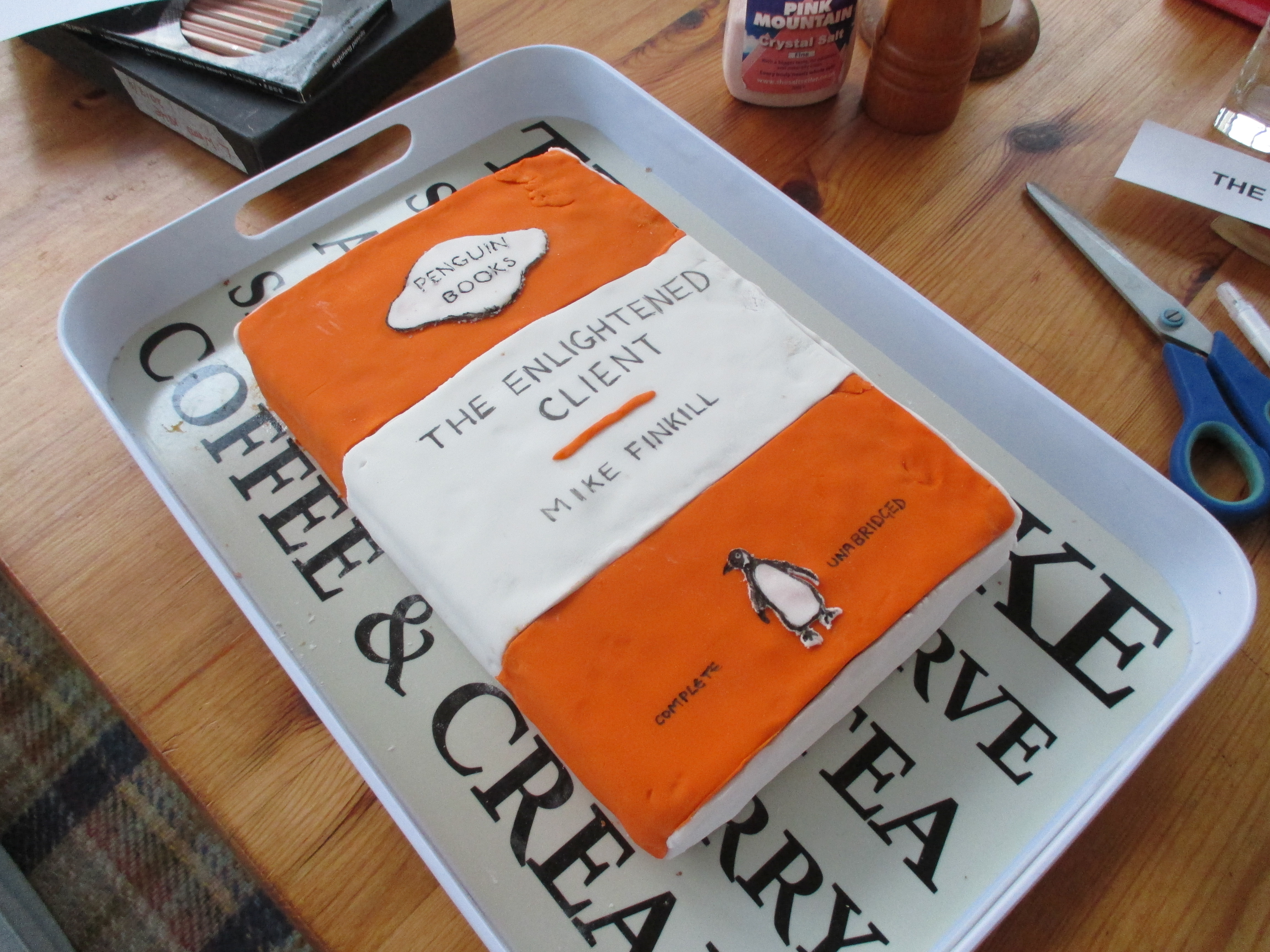
The assessment is weird too. It’s the sense of being judged by someone else (authoritative) hitting my own fragile sense of who I am as an artist (which still feels uncomfortable for me to ‘own’).  So the jolly cake I made for someone in Leeds Creative Timebank is a good image to counteract the angsty feelings.  I have another request now for cakes, for the Tea and Tolerance project (creative response to the Bull Lane Mosque in York offering tea and cake to defuse the anger of English Defence League protesters after the killing of Lee Rigby- cake, such a healing thing).

So, as usual, everything is fine except my unsettled mood.

I have three months or so to record the next stage of the MA ‘journey’. I went to Sunny Bank Mills yesterday to get the exhibition materials back.  I was really pleased to get a commendation from the show, and Jane has kept some of the stones, and asked me to frame some more of the photos, for potential sale in the gallery shop.

Have also taken lots of digital and film photographs for producing liquid light and cyanotype images on different substrates (including some wonderful flat, pale grey stones from Scottish beach).  Planning to produce these for Chapel Allerton Arts Festival (and maybe in my favourite local cafe), Love Arts Festival, as well as for myself and bespoke items for presents etc.

The End of Equality meeting is less than 2 weeks away now.  We have over 70 women booked in and lots of ideas for recording/harvesting.  This is exciting and a little bit scary.

I am going to propose setting up a camera obscura in Project 105 on Chapeltown Road in response to an open invitation for such ideas to engage people and support community in the area.

So it’s a busy time- need to schedule the work, as well as several other things that are happening.  Better get on…

Taking Place

IMG_0432

Writing this after a great, but tiring, holiday weekend.  My sleeping pattern is disrupted by the mental effort of writing up for the MA submission.  I do sometimes wonder whether all this is a good idea.   Does the emphasis on the intellectual stuff take away my pleasure (and time) of doing and making?  Anyway, for now, I am having a rest and letting the process happen without too much conscious effort.

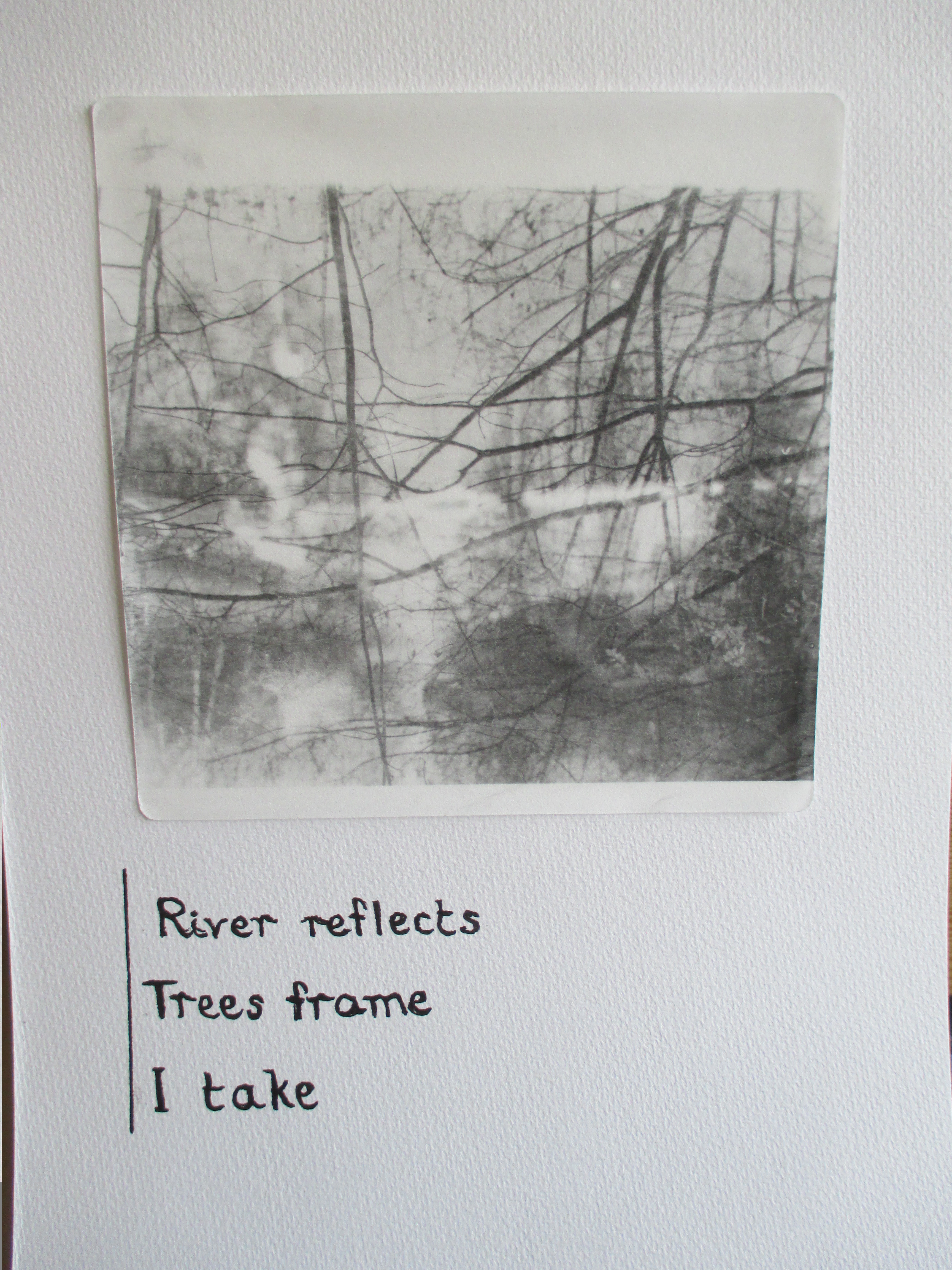
I made the little piece above after reading an essay by Alec Finlay about his exhibition called 5 poem-objects.  I wrote a review of the essay (see below), as an exercise in academic writing, for the MA.  All of which I enjoyed.  So the piece is a black and white 35mm photographic print developed using liquid light onto a square of waste paper from SCRAP at Sunny Bank Mills, mounted on watercolour paper with text handwritten by me.  I will take it to the next Situated Practice reading group on Monday and see what we make of it.  First time of including (my) text in the work.  Wish I had nicer handwriting.

Academic writing exercise, March 2015

Review of Alec Finlay essay ‘poetry is still beautiful’

Alec Finlay is a multi-media artist working across a variety of disciplines, graphic art, installation, interventions in the built environment which invite ‘audience’ participation and co-creation.  He also works with text and poetry, and response to place is an important element in his practice.  For many of these reasons, I find resonance between his work and my evolving practice.

The essay which this piece reviews was written by Finlay to accompany an exhibition, ‘Five poem-objects’, shown at the Ingelby Gallery in Edinburgh in 2012.

The poem-objects are 5 simply framed, plain linen handkerchiefs which have been embroidered in threads of different colours, by Jean Malone, with the following 5 phrases, sewn so as to look handwritten:

father is the war of all things

mother’s word is ward

family is a shipwreck

children are the revolution

our lives are a carrying stream

It is interesting to compare my reaction to these phrases before and after reading Finlay’s essay.  The phrases are themselves highly evocative and engaging, but the essay is an important accompaniment, augmenting the emotional and intellectual impact of the work.  The essay considers each element separately, as well as the complex threads which connect the narrative.  They are threads of family, circularity, the perpetual resonance and pull between poles of meaning, poetic expression and the flow of life.  The piece is lovely to me- in particular for its use of domestic objects and the layering of gentle but powerful meaning through use of text.

The piece has minimal content, so meaning is conveyed conceptually through the text.  The juxtaposition of father, mother, family, children brought together in the metaphor of a carrying stream are suggestive of timelessness and cycle of life (like Joni Mitchell’s Circle Game).  The carrying stream references Heraclitus’ aphorism, that you can’t step in the same stream twice.  He mentions another saying by Heraclitus- that the way up is the same as the way down, introducing another key theme, reversals of meaning and ambiguity which echo within concepts and words.  The first text: father is the war of all things, is an example, transposed from Heraclitus’ ‘war is the father of all things.  Finlay is the son of a famous father, Ian Hamilton Finlay, who is a recurrent presence in the essay- a dominant influence in whose illustrious footsteps Finlay walks, never an easy path.  Finlay alludes to this autobiographical aspect but stays with the subtlety of “diametric symmetry”, rather than any more direct expression.  This poetic ‘licence’ is beautifully realised throughout the essay.

The next quote refers to Paul Celan’s poem, ‘The Travelling Companion’, about his mother who died in the Holocaust (as did his father).  Celan anagramised his birth name, perhaps as a way of erasing some of his tragic life story, another word play. The quote- mother’s word is ward’- plays with the linked meanings and forms of word and ward.  It describes his mother providing reassurance through her words, which exist forever in her son, conceptualised in the poem as her soul- the eponymous Travelling Companion.

The next phrase- family is shipwreck- was inspired by a Brazilian poet, Haroldo Campos, who compared shipwrecks to poems.  He also compares the fitting of words into a matrix, constellations of meaning, with the complex patterns of human connection which we know most intimately in our families. This echoes Bracha Ettinger’s proposal that the trauma of birth, for both mother and baby, is a founding human experience- of vulnerability, separation, new life snatched from the jaws of death.  Our psyches formed in the shipwreck of mother and child.

And children are the subject of the next poem-object- children are the revolution. Interesting to consider this in light of Finlay’s identity as his father’s son.  He says relatively little about this phrase, as he describes it as ‘writing itself’.  Children bringing change, turning everything upside down and symbolising a transformed future.

The final phrase completes the cycle.  Our lives are a carrying stream, is a quote from Hamish Henderson, one of Finlay’s heroes.  Henderson was a maverick Scot, poet, folk-singer, Communist.  The phrase is from his self-penned eulogy, which was read at his funeral.  The whole poem optimistically likens the carrying stream to the eternal renewal of life, with new voices re-telling the old stories.  Henderson, like Finlay, was committed to the oral tradition, and the power of creativity to remake the world, to bring joy, and to nurture wisdom.  There is an echo of the dark side of the cycle in the death of Paul Celan who ended his life by drowning in the river Seine in Paris.

The final section of the essay, sub-titled ground, river and sea, reinforces the theme of the cycle of life and returns to memories of the ‘burns’ of his youth (burn is the Scottish word for a stream), The title of the essay, poetry is still beautiful, is from the writing of Tom Lubbock, near the end of his life, dying from a brain tumour which is leading to the fading away of language (he was a writer by trade).  This refers back to the ideas of Henderson (and Finlay) about the core function of art and creative process to human life.  As his consciousness declines, Lubbock still sees the beauty in poetry, becoming as he says “simply the world”.

A final paragraph brings the writing back to earth by excavating some of the history of some of the burns of his childhood.  He discovers an association with the first goddess of Scotland, Annait, and identifies other echoes of this ancient story written on the landscape- remains of a 2,300-year old lute, prehistoric temples and wells.  The last line of the essay is worth quoting in full:

“Annait, travelling companion, Earth Mother, Bride… whose new name is Gaia; there are no sacred texts describing her mythology and yet, in little burns and springs, She is the source from which the carrying stream flows.”

I find Finlay a very personally generous, open and humanistic artist, and love this essay.

Almost there

149

Nearly ready to hand in my journal for the next MA module so up early with too many thoughts and ideas rattling around my poor old brain.

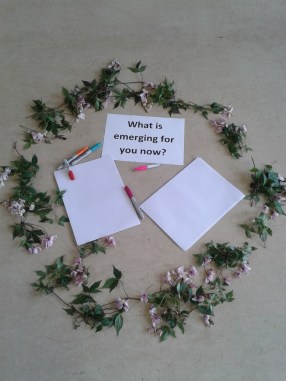
I have promised myself to post here weekly so here’s my effort for April Fool’s Day. The image is from an Art of Hosting gathering I helped to organise in December last year.  It’s here to illustrate another element of the art I want to do- broadly referred to as social practice.  It seems to mix more or less harmoniously with political or social ‘activism’ (Suzanne Lacy, Nato Thompson, Rick Lowe), and harks me back both to my working life and my own activism.

So, I’m trying to introduce ‘artistic intention’ in a piece of local activism here in Leeds.  I’m part of a group of women who are ‘hosting’ a conversation event in May with Bea Campbell coming to open things up by discussing her new book,   ‘End of Equality’.  Our aims are:

  • To respond to Bea’s book, and to find out what we all think is going on in these times
  • To chuck a pebble in the pond- get women together to talk and see what happens next- we hope more things will happen, and will want to stay involved
  • To recognise and support the new wave of women’s activism
  • There’s an old saying that ‘The world will change when the women talk’. We’ll see.

We’re establishing a social media presence and getting on with all the usual planning and organising.  And I’m trying to add the extra element of recording and orchestrating which can make it into ‘art’, without pushing my own agenda.  This takes a lot of thinking about.

So far I have asked women I know to film and photograph the event (permissions will be agreed).  We aim to gather words and thoughts in a range of ways.  We want to make space for more things to happen as a result of the event.  I plan to make books from the material gathered (hand-made, photo-books…).

I want to develop this practice and my confidence in it so as to include this element in my ‘toolkit’ for the main exploration, of people and place and connectedness.  Perhaps my continued reading of Doreen Massey will guide me towards integrating this more clearly.

Trying to connect and cohere

20141210_111400

I’ve just been away to East Yorkshire with friends and spent time walking along the coast and driving across the spacious, sparsely populated Yorkshire Wolds.  Came back to the task of writing up my work over the past 6 months for submission for my MA so my head is full of questions:

  • What is it I’m doing?
  • What is the thread which brings together all the different things I am interested in and make as my art practice?
  • Does it HAVE to be coherent?
  • Is it coherent at a sub-conscious level, emerging in the practice as I mine the process for meaning?

I also came back to a message from the Landscape & Arts Network (LAN) containing an inspiring account and video of their recent AGM and national gathering http://youtu.be/6j7QVxpviOw.

So… perhaps there are some links to be made, between my experience of being in the East Yorkshire landscape, the questions in my head, and the glimpse, from the video, of what other artists are thinking about the role of art in these times of tension and challenge for the environment.  We sometimes talk as if we forget that, although human activities are becoming ever more destructive, the environment will survive, however changed.  It is us, the people who live in troubled relationship with the ‘natural’ world, whose future is in doubt, along with many other living things.  So that makes some sense of my other key interest- in relationships between people and place (also explored brilliantly by Gregory Bateson, see http://cdm16621.contentdm.oclc.org/cdm/singleitem/collection/p16621coll1/id/999/rec/3).

I read the opening chapter of Doreen Massey’s book, For Space, last evening and was reminded about her proposal that space/place has the potential to redefine our perception of the world, enriching our experience by inviting us to ‘see’ more of what has ‘taken place’ (interesting expression in this context) there, and who or what have been the players in the dramas or the ‘music’ which have created it and sustain its dynamic flow.

In terms of my practice then… How it works at the moment is that I need to take time to be in a place (recent examples include:  Low Newton on the Northumberland coast; the Leeds-Liverpool canal in Armley:  Sunny Bank Mills in Farsley;  and what remains of Jewish Warsaw), so as to notice and delve into the stories contained.  I then try to record what I see, using photography, liquid light on found objects, rubbings, drawing, paper-casting of surfaces, cyanotype, working with maps and map fabric,  and kinetic ‘traces’ of movement in the landscape (using chalk pastels in paper-lined cylinders).  A key question for me is to link this activity with another aspect of practice, from my working life, which is working with people, on conversation, change, and ‘harvesting’ thoughts and words.

The Landscape & Arts Network information provided examples of how to link these two elements, for example, by engaging a range of people who study, live in and are the custodians of landscape (including those whose voices are less often heard, such as farmers) in conversation.  My tutor, Garry Barker, is helping me link the place and people aspects, noting my interest in social practice and suggesting ways to ‘curate’ conversations based on the ‘mosaic’ of different people’s understanding of place.

So maybe I am getting somewhere??

Here am I, I am here, Here I am, Am I here?

So where am I?

I’m in Leeds, in the first year of an MA in Creative Practice at Leeds College of Art.  I’m writing this in my small studio.  I’m exploring the ideas and practices that illuminate the kaleidoscopic connections between people and place, space and the non-human world.  In my case, me as a woman and everything else.

I aim to express these connections and stories through a range of creative practices.  These include 35mm film and camera-less photography, drawing, indexical mark-making, artist’s books, print-making, image transfer for conceptual purposes (for example, using stones and other found materials, and fabric soaked off the back of old maps), as well as social practice and place-based interventions.

I am looking for traces of the relationship between people and places, the stories we leave behind, and the complex meanings we create from our experience of place.  Some of this fits within the broad arena of psychogeography, and extends from there into humanistic geography and cultural studies.  I also wonder about the place of art in challenging power and safeguarding vulnerability.  I would like to be able, through my artistic practice to, as Bracha Ettinger puts it, express “care and compassion, in wonder and reverence”.  I am also interested in making visible that which is often unseen and in telling stories which are often not heard.

Before I retired I worked with people on change and development, and before that I did a fair bit of political activism.  I can’t seem to let this go and am trying to find ways to include working with people in my creative practice.